
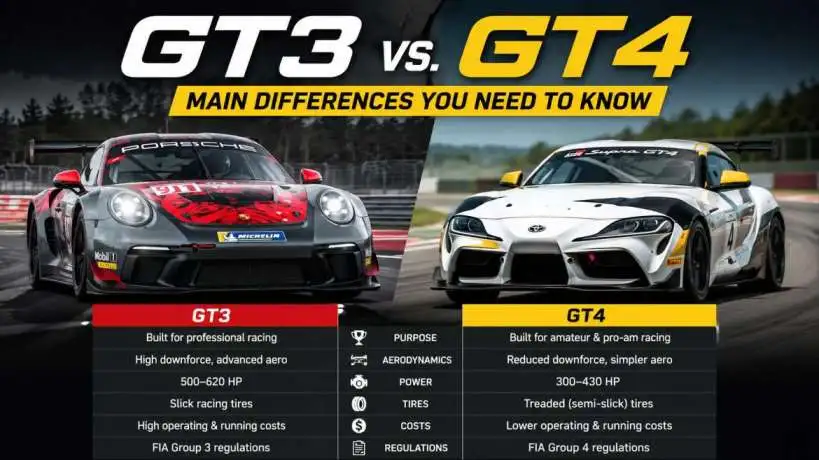
If you are new to watching car racing, you might get confused when you hear terms like GT3 and GT4. You might also see a GT2 car and wonder where it fits in. These are not just random names. They are different classes of race cars. Each class has a different level of speed, cost, and difficulty.
Think of it like a video game. You have easy mode, medium mode, and hard mode. GT4 is the easy mode. It is the best place to start. GT3 is the hard mode. It is what the pros use to win big races like the 24 Hours of Le Mans. GT2 is a special class that sits in the middle, but it is rare.
This article will explain the GT3 vs GT4 racing differences in full detail. We will also look at the difference between GT2, GT3, and GT4 racing. We will focus on the technical differences that make each car unique. By the end, you will know exactly which car is which and why it matters.
The Starting Point: What Does GT Mean?
Before we look at the numbers, let us look at the letters. GT stands for Grand Touring. This is an old term. In the past, it meant a car that was strong and comfortable for long drives. Today, in racing, it means a race car that started as a normal car you can buy from a shop.
The rules say a GT car must look like a road car. The shape must be the same. The main body frame must be the same. But inside, the engine is made stronger. The suspension is changed. The brakes are made bigger. The team adds a big rear wing. They strip out the seats and add a roll cage for safety.
This is what makes GT racing so fun to watch. You can see a car that looks like a Porsche or a BMW fighting for first place. It feels close to the cars we see on the street, but they are much, much faster.
You may also read :- Ford Mustang GT Review: V8 Performance and Driving Character
GT4 Racing: The Entry Level
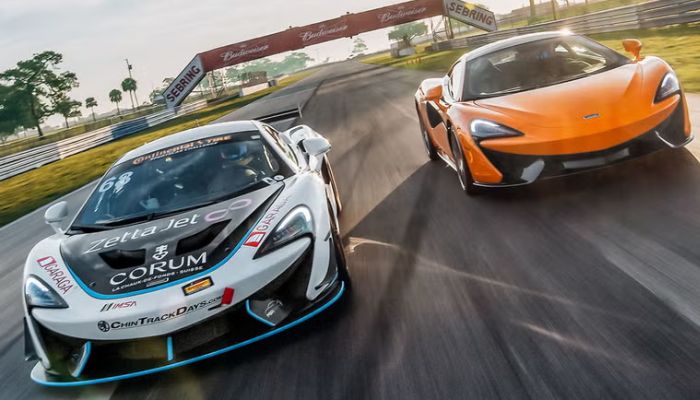
Let us start with the slowest of the three. But do not say "slow" to a GT4 driver. These cars are still very fast. They are just the easiest to handle.
What is a GT4 car?
The GT4 class was made for beginners and amateur drivers. These are people who have money or young drivers just starting their careers. The car is very close to the normal road car you can buy.
The rules say a GT4 car must keep most of its original parts. Almost 70% of the car is the same as the road version. The engine is the same. The frame is the same. You can even start some GT4 cars with the normal car key.
The Technical Differences of GT4
Here are the technical details of a GT4 car. These numbers are important for the technical differences between classes.
- Power: A GT4 car has about 400 to 500 horsepower.
- Weight: It is heavy. The car weighs around 1,350 to 1,450 kilograms.
- Aerodynamics: The wings are small. The car does not push itself into the ground very hard.
- Brakes: They use steel brakes. These are strong, but they get hot fast.
How Does a GT4 Drive?
A GT4 car is forgiving. This is the best word for it. If you press the gas too hard, the car will slide a little, but it will not spin out easily. If you turn the wheel too much, the car will understeer (go straight instead of turning), but it will not crash.
This makes GT4 perfect for learning. You can drive a GT4 for a long race without getting too tired. The car does not fight you. This is a big part of the GT3 vs. GT4 racing differences. The GT4 is a friend. The GT3 is a beast.
Cost of GT4
Money is a huge factor in racing. A GT4 car is the cheap option. To buy a new GT4 race car, you will pay around 160,000 to 270,000 USD (150,000 to 250,000 USD).
To run the car for a full season of races, you might pay 150,000 to 250,000. This covers tires, fuel, mechanics, and entry fees. It is a lot of money for a normal person. But for racing, it is a good deal.
GT3 Racing: The Professional Standard
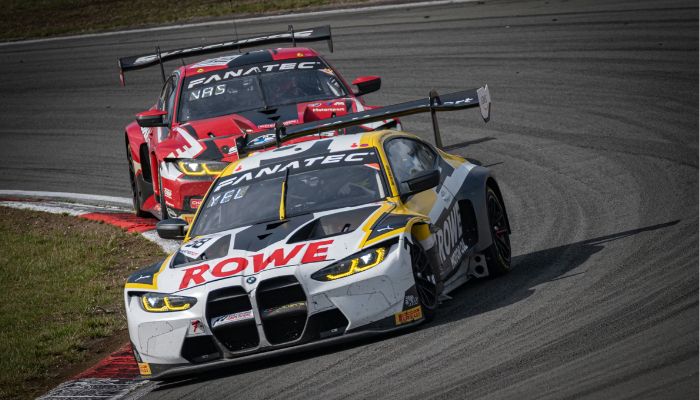
Now we move up. If GT4 is high school baseball, GT3 is the major leagues. The GT3 is the most popular GT racing class in the world. Almost every big race has a GT3 field.
What is a GT3 car?
The GT3 was made by the FIA (the boss of world racing) in the 2000s. They wanted a class for rich amateur drivers and professionals to race together. It worked very well. Now, manufacturers like Ferrari, Lamborghini, Porsche, BMW, and Mercedes all make GT3 cars.
The car looks like a road car. But under the skin, almost everything is changed. The engine is tuned to maximum power. The body is made of carbon fiber to save weight.
The Technical Differences of GT3
Here is where the numbers get bigger.
- Power: A GT3 car has 500 to 600 horsepower. Some push even higher.
- Weight: It is much lighter than the GT4. The car weighs about 1,200 to 1,300 kilograms.
- Aerodynamics: This is the biggest difference. GT3 cars have huge front splitters (blades under the nose). They have massive rear wings. They have diffusers at the back. At 200 mph, the air pushes the car down with more force than the car weighs.
- Brakes: Most GT3 cars use carbon brakes. These are expensive. But they do not get weak when hot. You can brake much later.
How Does a GT3 Drive?
A GT3 car is hard to drive. It wants to go fast. If you try to drive it slowly, it feels strange. The steering is heavy. The brakes grab hard. The engine wants to rev high.
You must be strong to drive a GT3. The steering has no power assistance (sometimes). The G-forces in corners push your body sideways. Professional drivers train like athletes to drive these cars for two hours straight.
The cornering speed is wild. In a fast corner, a GT3 car can go 10 to 15 mph faster than a GT4 car. That is a huge gap on a race track.
The "Balance of Performance" (BoP)
There is one special rule in GT3. It is called Balance of Performance or BoP. This is a tool the race organizers use to make all the cars equal.
Without BoP, a Ferrari might be much faster than a BMW. The organizers look at the cars. If the Ferrari is too fast, they add weight to the Ferrari. Or they reduce the air intake to lower its power. If the BMW is too slow, they remove weight.
The goal is to make every car finish within one second of each other. This makes the race about the driver, not the wallet.
Cost of GT3
Here is the scary part. A GT3 car is expensive. To buy one, you will pay between $400,000 and $650,000 ($400,000 to $600,000).
Running the car costs even more. A single set of tires might cost 2,000 and only last for 200 kilometers (about 1 hour of racing) [citation: 4]. The engine needs to be rebuilt after about 10,000 kilometers. That rebuild costs 2,000 and only lasts for 200 kilometers (about 1 hour of racing) [citation: 4]. The engine needs to be rebuilt after about 10,000 kilometers. That rebuild costs $30,000 or more.
A full season of GT3 racing can cost over $500,000. If you want to race at Le Mans, it can cost millions.
GT2 Racing: The Middle Child
You might ask, "Where is GT2?" Good question. GT2 is different. It was very popular in the past. Then it went away. Now, it is coming back, but it has a new job.
The History of GT2
In the 1990s and early 2000s, GT2 was the class just below the top cars. The top cars were GT1 (very expensive, almost like spaceships). GT2 was for production cars with less power.
But GT1 died because it was too expensive. Then GT3 became the top class. So GT2 had no place to go.
The Modern GT2
Today, a few manufacturers make GT2 cars. Porsche has the 935. Audi has the GT2. These cars are weird. They have more horsepower than GT3 cars. Some GT2 cars have over 700 horsepower.
But they have less aerodynamics. They have smaller wings. They do not push down as hard. Why? Because GT2 is made for "gentleman drivers" who want a lot of power but do not want to deal with complex air pressure setups.
Think of GT2 as a muscle car. It has a big engine and goes very fast in a straight line. But in the corners, it is harder to drive than a GT3 is. GT3 is science. GT2 is power.
The difference between GT2, GT3, and GT4 racing is simple:
- GT4: Low power, easy handling, cheap.
- GT2: High power, tricky handling, medium price.
- GT3: High power, good handling, expensive.
Most race series do not use GT2. It is a niche class for specific events.
Head to Head: GT3 vs GT4 Racing Differences
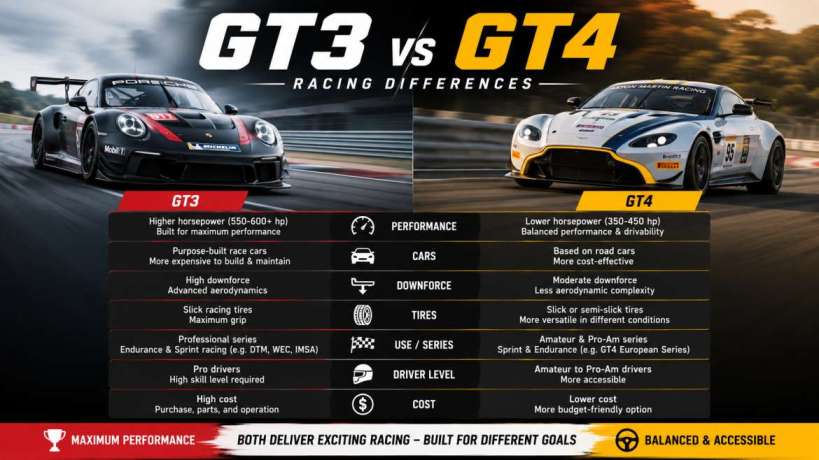
Now we put them side by side. This is the core of the GT3 vs. GT4 racing differences. Let us break it down into clear points.
1. Speed and Lap Time
The most obvious difference is speed. On a typical race track, a GT3 car is 5 to 10 seconds faster per lap than a GT4 car. Five seconds is a lifetime in racing.
The GT3 reaches higher top speeds. It brakes much later. It goes through corners much faster. If you watch a race with both GT3 and GT4 cars on the track at the same time (multi-class racing), the GT3 cars will pass the GT4 cars like the GT4 cars are standing still.
2. The "Feel" of the Car
This is important for the technical differences in driving feel.
When you drive a GT4, you feel the weight. You feel the body roll (the car leaning). It feels like a strong road car.
When you drive a GT3, you feel the downforce. At low speeds, a GT3 feels heavy and stiff. At high speeds, it feels glued to the road. You can take a high-speed corner flat out (without lifting your foot off the gas). In a GT4, you would have to brake hard for that same corner.
3. Safety and Electronics
Both cars have safety features. But the GT3 has more advanced electronics.
- GT4: Has ABS (anti-lock brakes) and traction control. These help the driver stop and accelerate safely.
- GT3: Has the same, but they are adjustable. The driver can turn a dial in the car to change how much the traction control helps. They can change the brake balance from the steering wheel. They have telemetry. This means the team watches the car data live on a computer screen.
4. Wear and Tear
GT4 cars are gentle on parts. The tires last longer. The brakes last longer. The engine can run for many hours without a rebuild.
GT3 cars break things. The tires degrade (get worse) after just 30 minutes of hard driving. The brakes glow red hot. The engine is always close to breaking. This is why GT3 teams need many mechanics. GT4 teams can sometimes run with just two or three people.
The Visual Differences (How to Spot Them)
You do not need to be a mechanic to tell these cars apart. You can use your eyes.
Look at the wing.
- GT4: The rear wing is small. It is close to the body of the car. It looks almost like a decoration.
- GT3: The wing is huge. It is high up in the air. It is often as wide as the car. It is connected by thin pillars (uprights).
- GT2: The wing is wide, but sometimes not as tall as GT3.
Look at the front bumper.
- GT4: The front bumper looks like the road car. It has normal fog lights and grilles.
- GT3: The front bumper has a massive splitter sticking out. It looks like a flat blade under the nose. It has big air intakes for cooling the brakes.
Look at the width.
- GT4: The car is almost the same width as the road car.
- GT3: The fenders are flared. The wheels stick out wider. The track (distance between the left and right wheel) is much wider.
Which one is better?
This depends on who you are.
If you are a beginner or a hobbyist with a good job, GT4 is better. You will have more fun. You will not crash as much. You will not go bankrupt buying tires. GT4 is about the joy of driving.
If you are a professional or a very rich and skilled amateur, GT3 is better. It is the pinnacle. Winning in GT3 means you beat the best in the world. The speed is addicting. The respect you get is higher.
GT2 is for the person who wants to show off power. It is for drag racing fans who want to go road racing. It is the least common, but it is very loud and aggressive.
The Future of GT Racing
The rules are changing slowly. The world is moving toward electric cars. But for now, the combustion engine (petrol engine) is still king in GT racing.
GT4 will stay the same. It is the perfect school for drivers.
GT3 is growing. More manufacturers are joining. There is even a new rule called "LMDh" that mixes GT3 cars with prototype cars at Le Mans. GT3 will be the top of the sport for at least the next ten years.
GT2 might grow, or it might disappear. It depends if people buy the cars.
One interesting thing is coming. Porsche is testing a new 911 GT4. This means the GT4 class is not dying. It is getting stronger.
Conclusion
The world of GT racing is a ladder.
- You start in GT4. You learn car control. You learn race craft. The car helps you stay safe.
- You move to GT2 (if you want raw power) or directly to GT3 (if you want science and speed).
- You end in GT3. You fight for overall wins. You become a hero.
The GT3 vs. GT4 racing differences are not just about speed. They are about money, safety, driver skill, and fun. GT4 is the smart choice for learning. GT3 is the dream choice for winning.
Now, when you watch a race on TV or play a racing game on your computer, you will know exactly what you are looking at. You will see the big wings of the GT3s fighting the smaller wings of the GT4s. And you will understand the difference between GT2, GT3, and GT4 racing forever.