
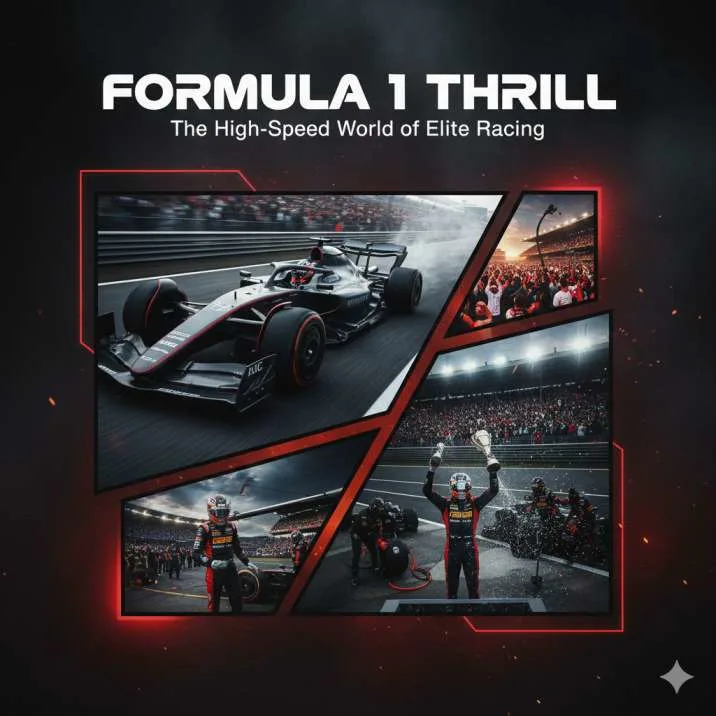
Take the noise of the loudest sound that you have ever heard. But now suppose sound is attached to a colored rocket on wheels, and it flies along so swiftly, that it is a blur. It is the first thing that comes to the mind of many people about Formula 1. And yet so much more than speed is the thrill of Formula 1. It is a combination of stunning technology, fearless drivers, and flawless cooperation. It is like playing a chess game at a fast paced game, each move matters.
What Makes Formula 1 So Exciting?
Ask every fan what draws him and they will all give you the answers. To others, it is the heart-thumping pace along the legendary tracks. It has been the Grand Prix weekend strategic drama to others. We had better divide the largest portions of the excitement.
Feeling the Raw Power and Speed of F1 Racing
The automobiles are fantastic devices. It takes them approximately two seconds to accelerate to 0 to 100 miles/hour. Jee, that is quicker than a supercar! The acceleration of the drivers back into their seats is greater than that of a roller coaster.
Also read :- Best F1 Races of All Time: The Greatest Grands Prix in History
The Engineering Genius Behind the Speed
The speed is possible due to the incredible engineering of an F1 car. Every single part has a job. This downforce is generated by the wings, and this is an invisible hand propelling the car on the track to perform the corners at insane speeds. The hybrid engine is a genius creation of power and efficiency. Millions of dollars are dedicated to teams and thousands of hours are devoted to searching a minute improvement. According to the words of the popular designer Adrian Newey, Aerodynamics is something people build engines cannot build. Here is the everlasting conflict between force and air circulation.
The Race Weekend: A Building Story
A Grand Prix is a very exciting event, and it begins several days before the actual race. The novel is written in a format of a good book, as the book progresses with each chapter providing more drama.
From Practice to Pole Position: The Tension Builds
To begin with, there are practice sessions. The teams put their cars to test and experiment with various setups. Then comes qualifying. It is at this point that the pole position battle occurs. The drivers are only given one lap to record the best time. The car that acquires a pole position begins at the frontline of the race. The tension is incredible. You get the sense of the drivers and the teams trying their best to focus their entire strength.
Race Day: Where the Thrill Comes Alive
This is it. The main event. There is a starting grid of twenty drivers. The lights go out... and GO! The shriek of the motors, the speed of the cars round into the first corner--is a moment never forgotten.
Mastering the Art of the Pit Stop
Race strategy is key. A fast lightning-fast pit stop will make or break a race. The pit crew are athletes, too. They are able to change four tires within two seconds! It is in itself a thrill seeing them work together in a perfect manner. It demonstrates that each member of the team is significant.
Overtaking Moves and Wheel-to-Wheel Action
The most enjoyable ones are the wheel-to-wheel racing wars. Speeding drivers drive within a one-inch distance at more than 200 miles per hour. An overtake, particularly at a well known corner such as the hairpin at Monaco or Copse at Silverstone leaves fans jumping out of their seats. It involves tremendous ability and more tremendous braveness.
The Heroes Behind the Wheel
The drama focuses on the drivers. They are not sitting in the automobile, but battling death forces.
The Physical Demand on F1 Drivers
The art of driving an F1 car is among the most difficult sports in the globe. The heart rate of a driver in a race is similar to that of a marathon member. The cockpit temperature can reach more than 100 degrees Fahrenheit. They lose a number of pounds of sweat alone. They must be hyper strong and they must also possess an incredible concentration capacity of two hours at a time.
Mental Toughness at 200 MPH
Mental challenge of motorsport is no less big. The drivers are expected to memorize more intricate track information, hear the plan of their engineer and make decisions in a split second, not to mention that they need to drive at maximum speed. A single digit will spell doom to an accident.
A True Team Sport
You may easily believe that F1 is a team of many people, but hundreds. The spear is driven by the driver.
Strategy, Teamwork, and Communication
There is collaboration of engineers, strategists and mechanics. F1 racing team approach is a kind of live chat. They determine when to pit, the kind of tires to use and how to respond to other teams. An excellent shout at the wall of the pit might enable a motorist to take a win when much behind.
The Global Celebration
Formule 1 visits the most spectacular cities in the world. The lights of Singapore to the ancient Monza, Italy, both races are festivals.
Experiencing the Atmosphere of a Live F1 Event
Spending time on a Formula 1 race is a dream of many. That voice quails in your heart. You can smell the gas and touch the power of the audience. It is an emotional, collective experience among people of the entire world who are fans of the same thing.
The Thrill of Formula 1 is for Everyone
You do not have to be an expert to appreciate it like a car. The novels are human novels: the revival, the struggles, the victory, and the tragedy. That is the thrill of Formula 1. It is a demonstration of human skill, technology, and passion, which happens each other Sunday, and never get tired of.
Frequently Asked Questions of the Thrill of Formula 1
Q: So what is the speed of Formula 1 cars?
A: On straight track segments such as in Baku or Monza, F1 cars have maximum speeds of more than 230 miles per hour (370 km/h). As quick as little air-ships!
Q: What is so crucial about the tires?
A: Tires constitute a giant component of the strategy. These are of various kinds: soft (fast yet wear out quickly), medium and hard (slower and last longer). The selection of the correct tire at opportune times is one of the keys to victory.
Q: What makes drivers safe driving at that speed?
A: The present F1 vehicles are survival capsules. Their shell is super-strong and is known as the survival cell, they have a halo device around the head of the driver to protect his head and they have special fire-proof clothes. The level of safety has been enhanced significantly.
Q: What is DRS that the commentators are referring to?
A: DRS is the abbreviation of the word, Drag Reduction System. It is a swinging element on the rear wing. Once a driver is near the car before him or her he/she can open it on straight to minimize air resistance and travel faster thus aiding in overtaking.
Q: Is it possible to drive a F1 car?
A: Not easily! You must have a special super license, and that must be years of success in the lower classes of racing. It also requires incredible physical fitness and reflexes of which few are endowed.